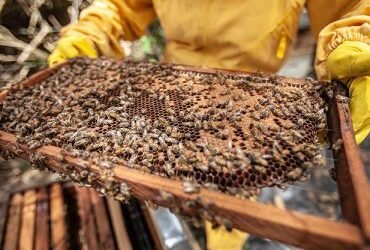
A single beehive itself takes up surprisingly little room — roughly 2 feet by 2 feet (about 0.6m x 0.6m) of ground footprint, plus vertical clearance of 3 to 5 feet as you add boxes (called “supers”) on top during the honey season.
But the hive footprint and the space a hive actually needs to thrive are two very different numbers. A colony’s real space requirement includes room for:
The hive structure itself
Safe working space for the beekeeper
A clear flight path for bees to come and go
Distance from neighbors, pets, and foot traffic
Room to expand if you add more colonies later
Space Requirements By Setup
Setup Recommended Ground Space Notes
Single backyard hive 10 x 10 ft (3 x 3m) minimum Enough for the hive plus working room
2–4 hives (hobbyist apiary) 15 x 20 ft (4.5 x 6m) Allows 2–3 ft between hives
Small commercial apiary (10+ hives) 1/4 acre or more Depends on hive spacing and equipment access
Urban/rooftop setup 6 x 6 ft per hive Often limited by railing height and flight path direction
These numbers are general guidelines rather than strict rules — your ideal setup depends on your local climate, the size of your property, and how many colonies you plan to keep.
Why Bees Need More Than Just “Box Space”
1. Working Room Around the Hive
As a beekeeper, you’ll need to open the hive regularly for inspections, especially during spring and summer. That means you need enough clearance on at least one side (ideally two) to:
Fully remove and rest hive frames without bumping into fences or walls
Set down a spare super or two while inspecting
Stand comfortably in your protective gear without feeling boxed in
A good rule of thumb is 3 feet of clear space on the side you’ll be working from, and at least 18 inches on the other sides.
2. Flight Path Clearance
Bees fly in a fairly direct line out of the hive entrance and gain altitude quickly once airborne — but only if nothing is blocking their initial launch. If a fence, wall, or hedge sits too close to the entrance, bees are forced to fly low across your yard at head height, which is when most “accidental” stinging incidents happen.
Best practice: angle hive entrances so bees fly toward an open area (like a field, driveway, or the sky) rather than directly across a patio, sidewalk, or neighboring yard. If space is tight, a 6-foot fence, hedge, or screen placed close to the hive forces bees to fly up and over rather than straight across at eye level — this is one of the most effective tricks for backyard and urban setups.
3. Distance Between Multiple Hives
If you’re planning more than one colony, spacing matters for both bee behavior and your own convenience:
2 to 3 feet apart is generally enough to prevent “drifting,” where bees mistakenly enter the wrong hive
Angling hives in slightly different directions (rather than lining them up in a perfectly straight row) also reduces drifting
Wider spacing (4+ feet) makes mowing, inspections, and equipment transport much easier
4. Distance From Property Lines, Pets, and People
Many towns and cities have specific setback rules for beekeeping — often somewhere between 10 and 25 feet from a property line, though this varies widely by location. Even where there’s no legal requirement, it’s good practice to:
Keep hives at least 10 feet from areas where people gather (patios, play areas, walkways)
Keep hives away from areas where pets or livestock frequently pass
Face entrances away from neighboring yards where possible
Always check your local zoning or agricultural ordinances before setting up — rules differ significantly between rural, suburban, and urban areas, and some cities cap the number of hives allowed per property.
Vertical Space Matters Too
Space isn’t just about the ground — a healthy, productive hive grows upward over the season. A single hive can start as one or two boxes in spring and grow to 4–6 boxes stacked by mid-summer as bees fill it with brood and honey stores. Make sure you:
Choose a spot with no low-hanging branches or overhangs above the hive
Leave enough headroom (5–6 feet) to comfortably lift and stack additional boxes
Avoid areas that flood or collect standing water, since hive stands need solid, dry, level ground
What If You Have a Small Yard?
You don’t need acres of land to keep bees successfully. Many beekeepers run thriving colonies on small urban lots, balconies, and even flat rooftops. To make the most of limited space:
Use a flyway barrier (fence, trellis, or dense shrub) to direct bees upward immediately upon exit
Position the hive in a corner facing away from human traffic
Keep just one or two hives rather than trying to scale up in a tight space
Provide a nearby water source (a shallow dish with pebbles works well) so bees aren’t tempted to visit a neighbor’s pool or birdbath
Don’t Forget Foraging Range
While it doesn’t affect how much land you personally need, it’s worth knowing that honeybees typically forage within a 2 to 3 mile radius of the hive, covering thousands of acres of natural foraging territory on their own. This means even a small backyard hive can support itself well, as long as there’s reasonable flowering vegetation somewhere in the surrounding area — you don’t need a large flower garden right next to the hive itself.
Quick Space Checklist
Before placing your hive, make sure you have:
✅ At least 10×10 ft of relatively flat, well-drained ground
✅ 3+ feet of clear working space on at least one side
✅ A flight path that doesn’t cross patios, walkways, or neighboring yards
✅ A flyway barrier if space is tight or entrances face a shared area
✅ Enough vertical clearance for boxes to stack as the colony grows
✅ Compliance with local setback and zoning rules
✅ A nearby water source for the bees